How Do You Find the Right Thermoplastic Polyurethane Film Supplier in China?
Choosing a Chinese TPU film supplier feels overwhelming. The wrong partner can cause product failures and delays. I'll show you how to ask the right questions to de-risk your procurement.
Finding the right supplier means going beyond data sheets. You must verify their expertise in your specific application, demand proof of certifications, and match their capabilities with your unique business needs for volume and customization. It's about finding a true partner.
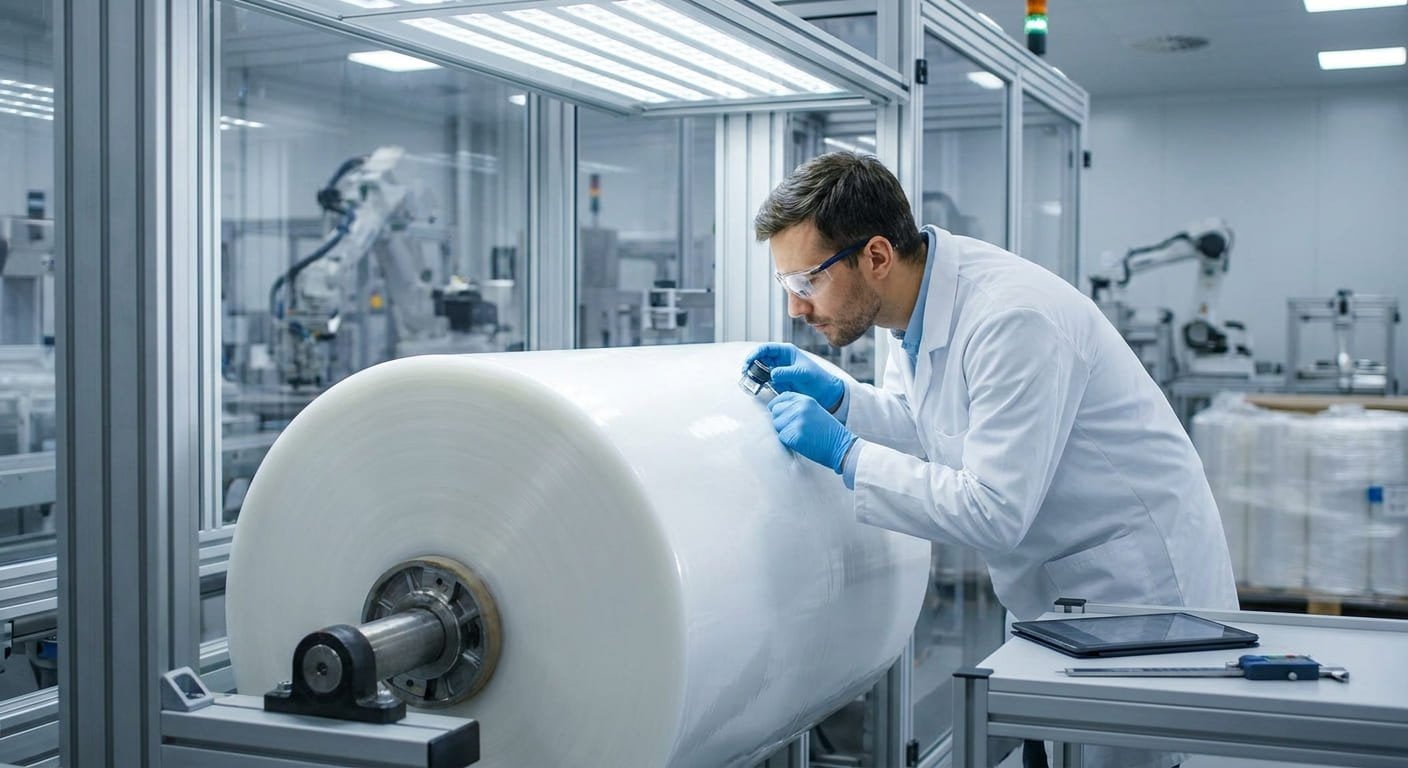
My team and I have been in the TPU film manufacturing industry for over 17 years. We have seen countless procurement managers make decisions that seemed good on paper but led to problems down the line. The key is to shift your mindset from simply buying a product to vetting a manufacturing partner. I want to walk you through the exact process we use to help our clients confirm we are the right fit for them. This will empower you to find a supplier you can trust for the long term.
Why Do Data Sheets Only Tell Half the Story?
You rely on technical data sheets to make decisions. But sometimes the film fails in the real world. You need to understand what the numbers on the page don't tell you.
Data sheets list parameters like thickness and strength but miss the most important factors. The underlying polymer formulation (polyether vs. polyester) and manufacturing consistency actually determine the film's real-world performance1 and longevity in your product.

A common mistake we see procurement managers make is focusing only on the numbers on a spec sheet. They might compare two films with the same thickness and moisture permeability and assume they are equal. But the real performance comes from the raw materials and the process. Based on our experience with project delivery, the base polymer is the most critical starting point. You need to ask a potential supplier why they chose a specific formulation for your product. Their answer will tell you everything about their expertise.
Polyether vs. Polyester TPU
The two main types of TPU are polyether-based and polyester-based. They have very different properties. A good supplier will recommend the right one based on your final product's environment and use case.
| Feature | Polyether-Based TPU | Polyester-Based TPU | Best For... |
|---|---|---|---|
| Hydrolysis Resistance2 | Excellent | Poor | Products exposed to water, moisture (e.g., medical tubing, waterproof mattress protectors). |
| Abrasion Resistance3 | Good | Excellent | Products needing high durability and wear resistance (e.g., automotive interiors, conveyor belts). |
| Low-Temp Flexibility | Excellent | Good | Products used in cold environments. |
| Oil & Chemical Resistance | Good | Excellent | Industrial applications with exposure to oils and solvents. |
Don't just ask for a data sheet. Ask your supplier: "For my waterproof mattress protector, are you recommending a polyether or polyester base, and why is that the best choice to prevent delamination after washing?"
How Do You Find a Supplier Who Is an Expert in Your Industry?
Many suppliers claim they can do everything. This often means they don't have deep knowledge in any single area. You need a specialist who truly understands your industry's demands.
To find an industry expert, ask for specific case studies and references for your application. A true specialist in medical films can discuss biocompatibility, while an expert in sun shades can detail UV-resistant formulations.

The TPU film needed for a blackout curtain is fundamentally different from the film used in a medical urine bag. A generalist supplier might not understand the critical nuances. When we develop a product, we always start with the end-use. A supplier who asks you deep questions about your application is one who likely has the expertise you need. Instead of just accepting a broad product catalog, you need to dig deeper into their real-world experience.
Medical vs. Apparel Applications
For medical products like waterproof mattress protectors or urine pads, biocompatibility and resistance to microbial growth are essential4. The film must meet strict hygiene standards and be gentle on the skin. In contrast, apparel applications, like waterproof jacket linings, prioritize breathability (moisture vapor transmission rate) and durability through many wash cycles. The right supplier for medical products understands ISO 10993 standards5, while the apparel expert knows OEKO-TEX testing6 inside and out.
Sun Protection vs. Automotive Applications
For sun protection products like blackout curtains or parasols, the key is UV stability and colorfastness. The TPU formulation must include additives that prevent the material from yellowing or becoming brittle when exposed to sunlight7 for years. For automotive interiors, the requirements are even more strict. The film must withstand extreme temperature cycles, resist abrasion, and meet stringent flame-retardant standards (like FMVSS 3028). An expert supplier will be able to provide test data specific to these demanding conditions.
How Can You Verify a Supplier's Certifications and Claims?
Every supplier website lists impressive certifications. But are they real, valid, and relevant to your product? An expired certificate can put your entire project at risk.
You must audit, not just accept, their claims. Instead of asking "Are you GRS certified?", ask "Can you provide a recent Transaction Certificate?". Always request current, verifiable documents for every single claim.

Trust is important, but verification is essential. In my career, I've seen brands face huge problems because they took a supplier's claims at face value. A certification is only meaningful if it's current, valid, and applies to the specific material you are buying. When we analyze quality inspection data, discrepancies often trace back to a misunderstanding of a standard or an outdated certification. You need to become a mini-auditor to protect your business. Don't feel shy about asking for proof. A confident, professional supplier will have this information ready and will respect you for asking.
From Claim to Proof
Here is a simple framework to turn a supplier's marketing claim into a verifiable fact.
| Supplier's Claim | Your Verification Question | What You Should Receive |
|---|---|---|
| "We are ISO9001 certified." | "Can you please send me a copy of your current ISO9001 certificate and the latest audit report?" | A valid certificate with a recent date and the name of the certifying body. |
| "Our film is OEKO-TEX compliant." | "What is your OEKO-TEX certificate number so I can verify it on their official website?" | A valid number you can check yourself on the OEKO-TEX label checker online. |
| "We produce GRS recycled TPU." | "Can you provide a Transaction Certificate (TC) for a recent GRS order similar to mine?" | A valid TC, which is the only real proof of a GRS-compliant supply chain.9 |
| "We have a large production capacity." | "What is your monthly output for this type of film? Can you share your equipment list?" | Specific numbers (e.g., 600,000 kgs/month) and a list of production lines. |
This simple shift from asking "Do you have it?" to "Show me the proof" changes the entire dynamic and ensures you are working with a transparent and legitimate partner.
What Makes a Supplier the 'Right Fit' for Your Business?
You're looking for the single "best" supplier. But the best for a huge brand could be a terrible choice for a growing business. You need to find the best supplier for you.
The 'right fit' is a supplier whose capabilities align with your business needs. This includes their minimum order quantities (MOQ), OEM/ODM customization depth, production capacity, and ability to meet your specific compliance demands.

Before you even start contacting suppliers, you need to be clear on your own priorities. The "best" supplier doesn't exist in a vacuum; they exist in relation to your specific needs. A large automotive company needs a supplier with massive, automated production lines and a history of passing strict audits. A startup creating a new type of eco-friendly bag needs a supplier who is flexible, has low MOQs, and holds GRS certification. Creating your own scorecard first will save you countless hours and help you quickly disqualify suppliers who are not a good match.
Assess Your Priorities
Before you begin your search, rank these factors from most important to least important for your business:
- Production Volume & MOQ: Are you placing a small trial order or a massive container load? A supplier's Minimum Order Quantity (MOQ) can be a deal-breaker. Be upfront about your expected volume. A supplier with a high capacity of 800,000 kgs per month may not be the right fit for a 500 kg trial order.10
- Customization (OEM/ODM) Needs: Do you need a standard, off-the-shelf product, or do you require a custom formulation, color, thickness, and width? Not all suppliers have strong R&D departments. Ask about their OEM process and their experience developing custom solutions.
- Compliance and Certification: What specific standards are non-negotiable for your market? (e.g., REACH for Europe11, OEKO-TEX for apparel). Create a checklist of required certifications and use it as a first-pass filter.
- Supply Chain Stability: How important is lead time and on-time delivery? Ask about their raw material sourcing, production planning process, and logistics capabilities. A vertically integrated supplier often has more control over their supply chain.12
By defining what you need first, you can approach the market with a clear set of requirements. This lets you control the conversation and find a true partner who can help your business grow.
Conclusion
Finding the right TPU film supplier is about deep vetting. It's about finding a manufacturing partner whose expertise and capabilities perfectly match your product and business goals.
"Thermoplastic polyurethane - Wikipedia", https://en.wikipedia.org/wiki/Thermoplastic_polyurethane. Sources in polymer science confirm that the choice between a polyether or polyester backbone in thermoplastic polyurethane (TPU) is a primary determinant of the material's final properties, including hydrolytic stability, abrasion resistance, and chemical resistance. Evidence role: general_support; source type: education. Supports: The claim that the chemical base of a TPU (polyether or polyester) fundamentally dictates its key performance characteristics, such as durability, resistance to environmental factors, and flexibility.. ↩
"A Comparison of Ester‐ and Ether‐Based Bio‐TPUs With Regard to ...", https://pmc.ncbi.nlm.nih.gov/articles/PMC12449858/. Technical literature on polymer chemistry explains that the ether linkages in polyether-based TPUs are inherently more resistant to hydrolysis than the ester linkages in polyester-based TPUs, which are susceptible to cleavage when exposed to moisture, particularly at elevated temperatures. Evidence role: mechanism; source type: paper. Supports: The claim that polyether-based TPUs are significantly more resistant to hydrolysis (degradation by water) than polyester-based TPUs.. ↩
"Mechanical Properties of Additively Manufactured Thermoplastic ...", https://pmc.ncbi.nlm.nih.gov/articles/PMC7767280/. Material science comparisons often note that the higher polarity and intermolecular forces associated with the ester groups in polyester-based TPUs contribute to superior toughness and abrasion resistance, making them suitable for high-wear applications. Evidence role: general_support; source type: research. Supports: The claim that polyester-based TPUs generally exhibit higher abrasion resistance compared to polyether-based TPUs.. ↩
"Basics of Biocompatibility: Information Needed for Assessment by ...", https://www.fda.gov/medical-devices/biocompatibility-assessment-resource-center/basics-biocompatibility-information-needed-assessment-fda. Regulatory bodies and standards organizations for medical devices mandate that materials in contact with patients must be biocompatible to avoid adverse reactions. For applications involving fluids or prolonged skin contact, resistance to microbial growth is also a key consideration to prevent infection. Evidence role: general_support; source type: institution. Supports: The claim that materials used in medical devices that contact the body must be biocompatible and often require microbial resistance.. ↩
"Use of International Standard ISO 10993-1, "Biological evaluation of ...", https://www.fda.gov/regulatory-information/search-fda-guidance-documents/use-international-standard-iso-10993-1-biological-evaluation-medical-devices-part-1-evaluation-and. The ISO 10993 series of standards, titled 'Biological evaluation of medical devices,' provides a framework for assessing the biocompatibility of materials and devices to manage biological risks arising from their use. Evidence role: definition; source type: institution. Supports: The definition and purpose of the ISO 10993 standards.. ↩
"Oeko-Tex - Wikipedia", https://en.wikipedia.org/wiki/Oeko-Tex. OEKO-TEX is a global system of independent testing and certification for textile products. Its standards, such as STANDARD 100, certify that every component of an article has been tested for harmful substances and is therefore harmless for human health. Evidence role: definition; source type: institution. Supports: The definition and purpose of the OEKO-TEX standards.. ↩
"Photodegradation and photostabilization of polymers, especially ...", https://pmc.ncbi.nlm.nih.gov/articles/PMC4320144/. Research in polymer science shows that exposure to ultraviolet (UV) radiation can initiate photo-oxidative degradation in TPUs, leading to chain scission and the formation of chromophores, which results in embrittlement and yellowing. UV stabilizers and absorbers are common additives used to mitigate this effect. Evidence role: mechanism; source type: paper. Supports: The claim that sunlight causes TPU to yellow and become brittle and that additives can prevent this.. ↩
"[PDF] TP-302-03 - NHTSA", https://www.nhtsa.gov/sites/nhtsa.gov/files/tp-302-03.pdf. The U.S. Federal Motor Vehicle Safety Standard No. 302 (FMVSS 302) specifies burn resistance requirements for materials used in the occupant compartments of motor vehicles to reduce deaths and injuries caused by vehicle fires. Evidence role: definition; source type: government. Supports: The definition and purpose of the FMVSS 302 standard.. ↩
"What is the GRS certificate and how can you get it?|… - Recover", https://recoverfiber.com/newsroom/what-is-grs. According to Textile Exchange, the organization that manages the Global Recycled Standard (GRS), a Transaction Certificate (TC) is a document issued by the certification body that verifies the GRS material in a specific shipment meets the standard. It serves as the key mechanism for passing a claim through the supply chain. Evidence role: definition; source type: institution. Supports: The claim that the Transaction Certificate is the key document for verifying a specific GRS-compliant transaction.. ↩
"Economic order quantity - Wikipedia", https://en.wikipedia.org/wiki/Economic_order_quantity. Manufacturing and supply chain principles indicate that high-capacity production lines are optimized for long, continuous runs to achieve economies of scale. The setup costs, changeover times, and administrative overhead for small orders can be prohibitive, leading large suppliers to establish high Minimum Order Quantities (MOQs). Evidence role: mechanism; source type: other. Supports: The claim that high-capacity manufacturers often have high MOQs that are unsuitable for small orders.. ↩
"EU REACH - International Trade Administration", https://www.trade.gov/eu-reach. REACH is a regulation of the European Union, adopted to improve the protection of human health and the environment from the risks that can be posed by chemicals. It stands for Registration, Evaluation, Authorisation and Restriction of Chemicals and is managed by the European Chemicals Agency (ECHA). Evidence role: definition; source type: government. Supports: The definition and purpose of the European Union's REACH regulation.. ↩
"[PDF] Building Supply Chain Resilience Through Vertical Control", https://people.duke.edu/~rps23/VerticalControl.pdf. Business and supply chain management literature defines vertical integration as a strategy where a company owns or controls its suppliers, distributors, or retail locations. This control can lead to greater stability in the supply of raw materials, reduced lead times, and more consistent quality. Evidence role: definition; source type: education. Supports: The claim that vertical integration enhances a company's control over its supply chain.. ↩